
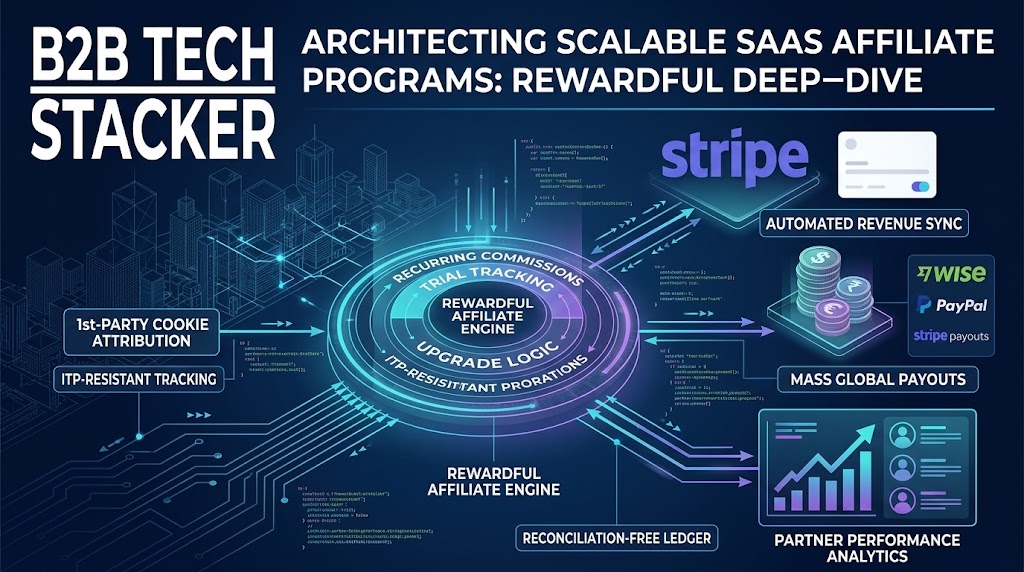
Skip the reading. Deploy this exact architecture and consolidate your B2B tech stack today.
Architecting Scalable Affiliate Programs for SaaS: A Deep-Dive Technical Review of Rewardful
In the rapidly evolving landscape of Software as a Service (SaaS), customer acquisition costs (CAC) continue to climb. Paid search is saturated, outbound sales motions are increasingly expensive, and organic search requires years of compounding effort to yield significant dividends. As a result, many technology companies are pivoting heavily toward partnership and affiliate marketing—a performance-based acquisition channel that aligns incentives perfectly. You only pay when a conversion occurs. However, traditional e-commerce affiliate platforms fall fundamentally short when applied to the subscription business model.
SaaS businesses don’t just process one-time transactions. They deal with recurring billing, trial periods, upgrades, downgrades, prorations, cancellations, and refunds. If your affiliate tracking software cannot inherently understand these complex billing lifecycle events, your finance team will be locked in an endless cycle of manual reconciliation, and your marketing engineers will spend countless hours patching together broken webhook pipelines. Enter Rewardful, a platform purpose-built to solve the exact technical hurdles of SaaS affiliate tracking.
In this comprehensive technical review, we will dissect the architecture, integration mechanics, campaign management flexibility, and treasury operations of Rewardful. We will explore why it has become the de facto standard for companies running on Stripe and Paddle, and how it empowers developers and marketers alike to launch robust partner programs in mere minutes rather than months.

The Fundamental Flaw in Traditional Tracking: Why SaaS Demands a Custom Architecture
To appreciate the engineering behind Rewardful, one must first understand the limitations of legacy affiliate networks. Traditional systems rely primarily on client-side tracking pixels placed on a “Thank You” or order confirmation page. When a user completes a checkout, the pixel fires, a static commission is calculated based on the cart total, and the transaction is recorded. This works flawlessly for shipping a physical product. It fails spectacularly for a SaaS product.
Consider a standard SaaS user journey: A prospect clicks an affiliate link, lands on your marketing site, and signs up for a 14-day free trial. At this exact moment, no revenue has been generated. Two weeks later, the system automatically bills the user’s credit card on file for a monthly subscription. Six months later, the user upgrades to an enterprise tier. Two months after that, they request a partial refund for downtime. Traditional tracking pixels cannot dynamically follow this user through a six-month asynchronous billing journey spanning multiple database states and third-party payment gateways.
Rewardful solves this by entirely abandoning the reliance on checkout pixels for revenue attribution. Instead, it utilizes a hybrid architecture: it handles attribution via a lightweight client-side script, but it derives all financial and commission logic directly from the payment processor (primarily Stripe). This server-to-server synchronization guarantees that the affiliate dashboard and your actual bank deposits are perfectly mirrored. There is no discrepancy, no missed webhooks, and no manual data entry required.
Deep Technical Dive: The Stripe Integration Mechanics
For developers, integrating third-party tools can often be a source of immense friction, involving wading through poorly documented APIs, managing state across disparate systems, and handling edge-case errors. Rewardful’s approach to Stripe integration is arguably its most compelling technical advantage. It operates on a philosophy of “zero configuration” backend sync.
The integration process involves exactly two steps. First, you connect your Stripe account via OAuth. Second, you place a highly optimized, asynchronous JavaScript snippet on your application’s frontend. That is the entirety of the setup. Let’s break down exactly what happens under the hood when a user interacts with this system.
When a visitor arrives via an affiliate link (e.g., `?via=partner`), the Rewardful JavaScript snippet catches the URL parameter. It then sets a first-party cookie on the user’s browser (overcoming many stringent third-party cookie blockers like Safari’s ITP) and stores the affiliate identifier in `localStorage` as a fallback mechanism. When the user eventually decides to sign up and input their credit card, Rewardful dynamically injects a `client_reference_id` (the affiliate’s unique token) into the Stripe Checkout session or directly attaches it as `metadata` to the Stripe Customer object if you are utilizing Stripe Elements or a custom API integration.
From that moment forward, Rewardful steps back and lets Stripe do the heavy lifting. Rewardful registers specific webhooks on your Stripe account. It passively listens for events such as `invoice.payment_succeeded`, `customer.subscription.updated`, and `charge.refunded`. When Stripe bills the customer for their recurring monthly fee, Stripe emits the `invoice.payment_succeeded` webhook. Rewardful receives this payload, inspects the Customer object, identifies the attached affiliate metadata, calculates the appropriate commission percentage based on your campaign settings, and immediately updates the affiliate’s dashboard. Because the source of truth is strictly your payment processor’s ledger, the system is mathematically infallible. If Stripe registers an upgrade, Rewardful automatically calculates the prorated commission increase. If a user churns and their subscription is canceled, Rewardful automatically halts future commissions without any API calls required from your own application servers.

Advanced Campaign Structuring and Program Customization
While the backend architecture handles the heavy lifting of revenue tracking, the frontend campaign management suite provides marketing teams with granular control over the economics of the partner program. SaaS companies rarely have a one-size-fits-all partnership model. You might have standard affiliates who earn a 20% recurring commission, certified agency partners who command a 30% commission, and strategic integrations that require a custom flat-fee bounty payout.
Rewardful handles these complex hierarchies through its Campaign management engine. Administrators can create unlimited distinct campaigns, each with entirely isolated rulesets. You can configure commissions to be a percentage of revenue (ideal for MRR-based SaaS) or a fixed amount per conversion (ideal for high-ticket annual enterprise deals). Furthermore, you can define the duration of the commission. You might choose to pay a 20% commission for the first 12 months of a customer’s lifetime, after which the attribution expires, encouraging affiliates to continuously drive fresh leads rather than resting on legacy recurring revenue.
Another powerful feature is the ability to implement double-sided incentives. In B2B software, conversion rates dramatically increase when the referred user also receives a benefit. Rewardful integrates directly with Stripe Coupons to enable this. You can configure a campaign so that the affiliate receives a 25% commission, and any user who clicks their unique link automatically has a “First Month Free” or “10% Off Forever” coupon automatically applied to their Stripe Checkout session. The Rewardful script handles the coupon injection dynamically, eliminating the need for users to manually remember and type in promo codes, thereby drastically reducing friction at the point of conversion.
Segmentation is also seamlessly managed. Campaigns can be set to public (allowing anyone to sign up via a branded portal hosted by Rewardful) or private (invitation only). This allows enterprise SaaS companies to run highly exclusive, white-glove partner programs alongside broad, public affiliate marketing efforts without the data or portals overlapping.
Treasury Operations: Simplifying Mass Payouts and Compliance
One of the most frequently overlooked aspects of building an affiliate program is the financial operations overhead. Tracking commissions is only half the battle; actually moving money to dozens, hundreds, or thousands of affiliates located in different countries, dealing with different currencies, and adhering to tax compliance laws is a logistical nightmare for finance departments.
Without a dedicated tool, a finance manager must manually export CSVs of owed commissions, log into a corporate bank account or PayPal, manually type in email addresses and amounts, double-check for data entry errors, and pray they haven’t double-paid an affiliate for a customer who recently requested a refund. Rewardful transforms this multi-day operational headache into a five-minute task.

Rewardful aggregates all owed commissions into clear, easily digestible payout reports. It inherently understands the concept of “holding periods.” You can configure the system to only mark a commission as “Due” after 30 or 60 days have passed since the transaction. This is a critical risk mitigation feature for SaaS companies, ensuring that you do not pay out cash to an affiliate for a transaction that subsequently results in a credit card chargeback or a refund request.
When it is time to execute the payouts, Rewardful offers seamless mass-payout integrations. The most notable is its deep integration with Wise (formerly TransferWise) and PayPal. With a few clicks, you can authorize a batch payout. The system connects to your Wise account via API and automatically distributes the precise funds to every affiliate in their preferred local currency, handling all forex conversions and transaction fees transparently. Once the mass payout is executed, Rewardful automatically loops back and marks all those specific commissions as “Paid” in the dashboard, providing an end-to-end, fully reconciled ledger.
Attribution Accuracy, SEO Benefits, and The Developer Ecosystem
From a technical marketing perspective, attribution accuracy is paramount. Because Rewardful utilizes first-party cookies (set on your own domain, e.g., `yoursite.com`) rather than third-party tracking domains, it is highly resilient against the increasing wave of privacy-focused browser updates, AdBlockers, and Intelligent Tracking Prevention (ITP) algorithms. This guarantees that your affiliates actually get credit for the traffic they drive, fostering trust and loyalty within your partner ecosystem.
Furthermore, Rewardful allows you to set up custom subdomains for your affiliate links (e.g., `partners.yourdomain.com`). This provides significant SEO benefits. When affiliates link to your site, they are passing link equity directly to your primary domain, rather than passing it to a generic third-party redirect network. This seemingly minor technical detail can have massive long-term implications for your organic search rankings.
For advanced technical teams, Rewardful exposes a comprehensive RESTful API and its own set of outgoing webhooks. While the core platform requires zero custom coding, the API allows engineering teams to build entirely custom experiences. You could, for example, use the API to natively embed the affiliate dashboard directly within your own SaaS application’s settings panel, completely white-labeling the experience. You can query affiliate stats, generate custom links programmatically, and trigger custom workflows in your own CRM (like Salesforce or HubSpot) whenever a new affiliate joins or a new commission is generated.
The Final Verdict: A Mission-Critical Component of the Modern SaaS Stack
Scaling a B2B SaaS company requires moving beyond brute-force paid advertising and building sustainable, scalable acquisition loops. An affiliate and partner program is one of the most effective loops available, but only if the underlying infrastructure is robust, accurate, and completely decoupled from manual operational overhead.
Rewardful has positioned itself not just as an affiliate tracking tool, but as a critical piece of financial infrastructure for subscription businesses. By natively integrating with Stripe at the API level, it eliminates attribution errors, automates complex refund and proration math, and turns the nightmare of mass payouts into a streamlined, automated workflow.
Whether you are a solo founder launching your first micro-SaaS or an established enterprise team looking to migrate away from clunky, outdated affiliate networks, Rewardful provides the exact technical specifications required to scale a modern partner program without burying your engineering and finance teams in technical debt.
Ready to supercharge your SaaS growth and build a frictionless partner program? The implementation takes less than 15 minutes.

Start your 14-Day Free Trial of Rewardful Today
