
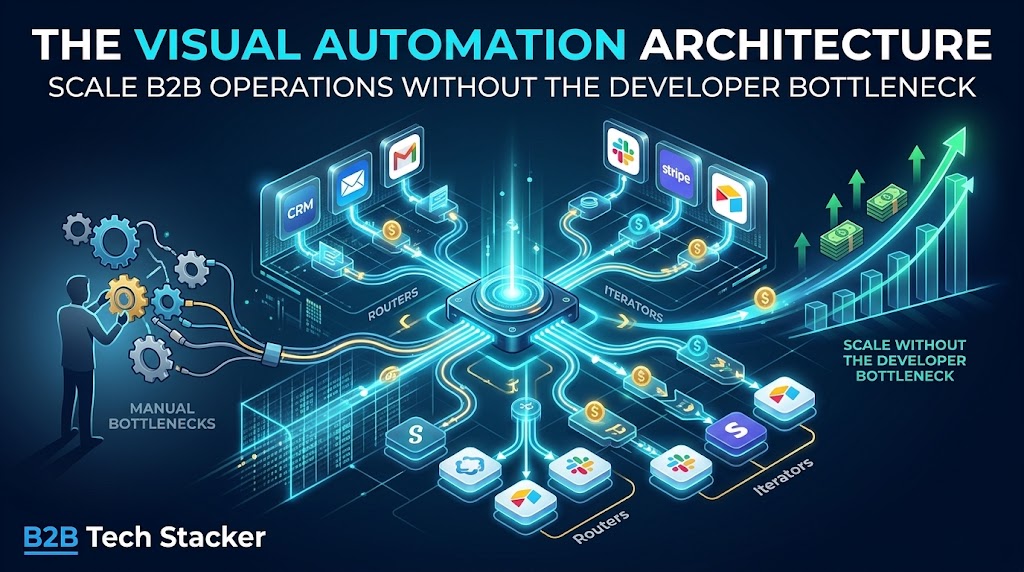
Skip the reading. Deploy this exact architecture and consolidate your B2B tech stack today.
The Hidden Cost of Human Middleware in SaaS Operations
In the modern B2B ecosystem, agencies and SaaS founders frequently fall into a dangerous operational trap: they deploy incredibly powerful software, but connect it using “human middleware.” When your sales team has to manually copy leads from a Facebook Ad into your CRM, or your FinOps team manually cross-references Stripe failures with an Excel spreadsheet, you are heavily capping your ability to scale.

To break past revenue plateaus, your tech stack must communicate autonomously. While many operators default to linear, rigid automation tools, true architectural scale requires a visual, multi-dimensional integration platform. Enter Make. Make is not just an automation tool; it is a visual command center for your entire software ecosystem.
Visual Architecture: Build Faster Than Ever
The fundamental flaw of legacy automation platforms is their linear, step-by-step constraint. If you want to build complex logic—like checking a database, routing data to different CRMs based on lead score, and sending a Slack alert—linear builders become impossible to read, manage, and debug.
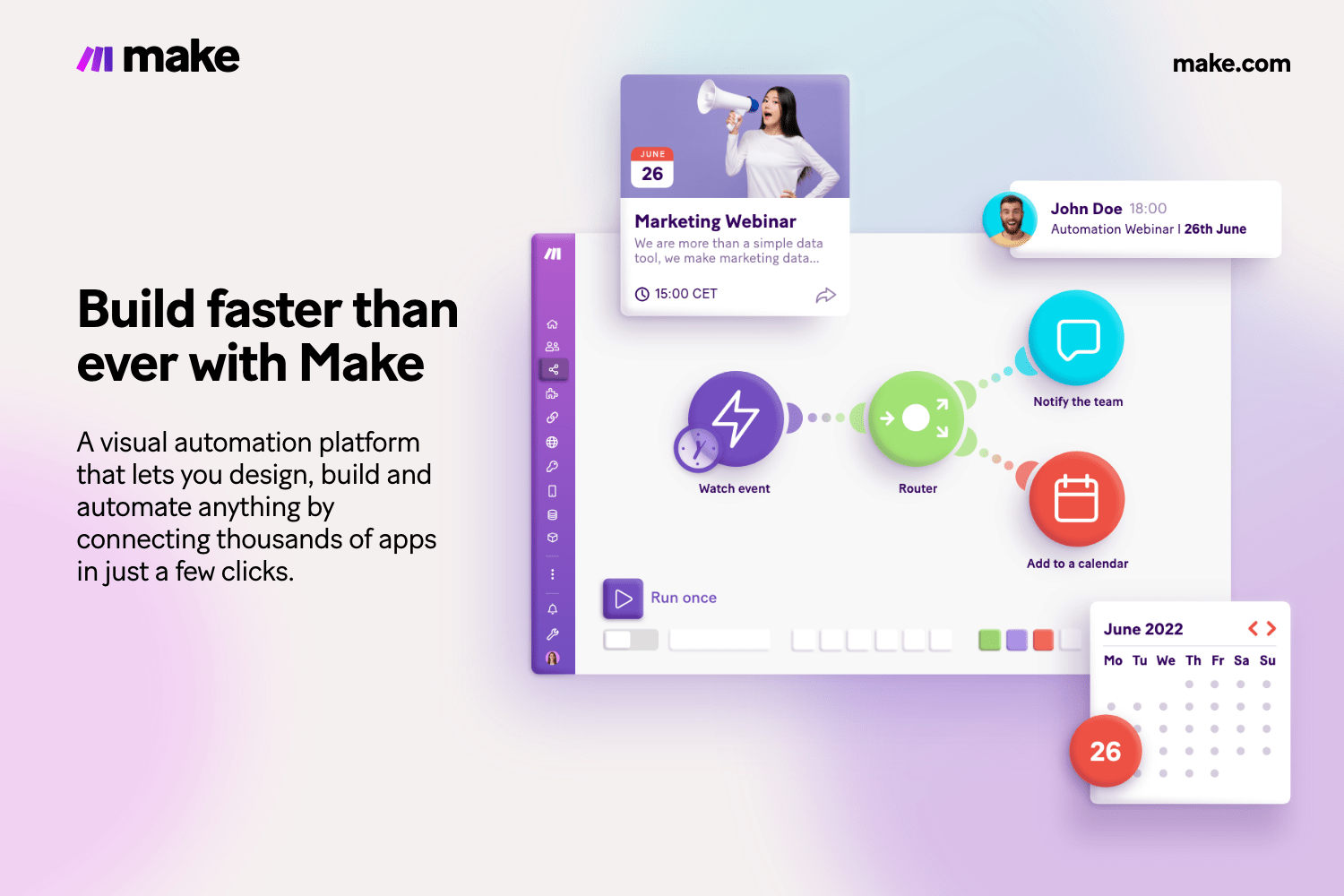
Make utilizes an infinite visual canvas. Instead of scrolling through endless text menus, you map out your data flow like a network architect. You can visually construct complex, branching logic with routers, iterators, and aggregators. This spatial awareness allows RevOps teams to build integrations significantly faster, spotting bottlenecks and optimizing data workflows instantly.
Connecting the Fragmented Tech Stack
Every new tool you add to your agency introduces potential API fragmentation. If your webinar software doesn’t natively speak to your email autoresponder, you lose the lead.
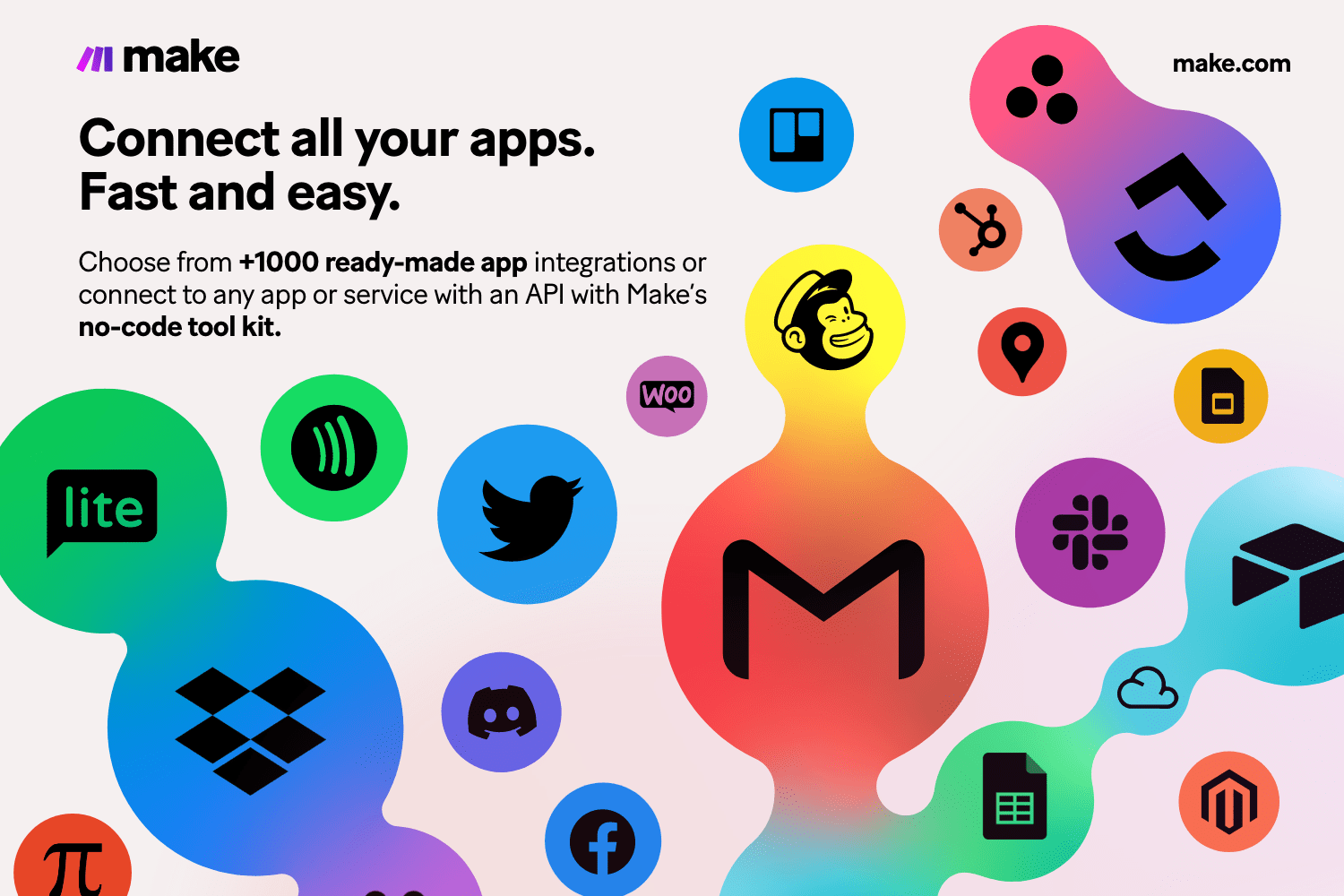
With thousands of pre-built app integrations and a universally adaptable HTTP/REST API module, Make bridges the gap between disparate systems. Whether you are using mainstream platforms like HubSpot, Slack, and Airtable, or proprietary, custom-built webhooks, you can easily connect your applications and ensure seamless data synchronization across your entire tech stack.
Automating the Repetitive to Focus on Scale
Growth is restricted when your highest-paid talent is performing routine data entry. The ultimate goal of system architecture is to remove operational drag so your team can focus entirely on high-leverage, revenue-generating activities.
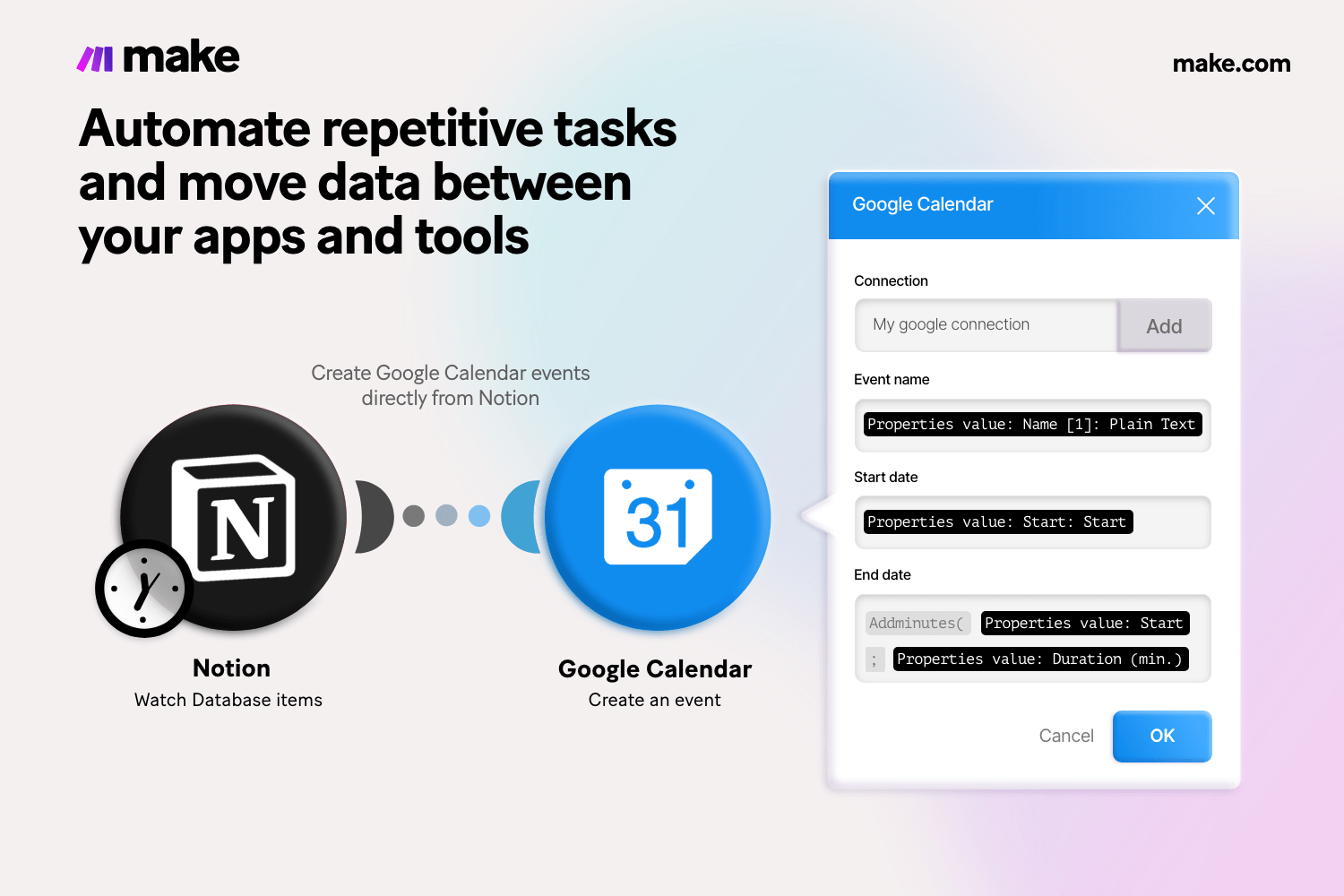
By delegating standard procedures—like onboarding new clients, generating monthly analytics reports, or parsing incoming email attachments—to autonomous scenarios, you eliminate human error. You are effectively hiring a tireless digital workforce that executes your processes flawlessly 24/7.
From Simple Workflows to Enterprise Solutions
While Make is incredibly accessible for simple, two-step data transfers, its true power lies in its enterprise-grade data manipulation.

It natively handles advanced error handling, allowing you to build fallback routes if an API endpoint goes down. With built-in text parsers, JSON/XML extractors, and mathematical operators, you can transform and calculate data mid-flight before it ever hits its final destination. From a basic lead capture to a deeply complex FinOps reconciliation matrix, Make scales effortlessly alongside your business.
Conclusion: Deploy Your Autonomous Architecture
Eliminate the fragmentation tax and stop paying your team to act as human middleware. By deploying a visual automation architecture, you drastically lower your Total Cost of Ownership (TCO) while multiplying your operational output.
Reclaim your bandwidth and start building your custom automation engine today. Click here to register for Make and start building for free.