

Skip the reading. Deploy this exact architecture and consolidate your B2B tech stack today.
Most B2B marketing teams don’t have a technology stack. They have a collection of subscriptions held together by hope and habit. A tool for email here, a platform for analytics there, an automation layer that was supposed to solve everything but quietly became another source of friction. Sound familiar?
The problem isn’t the tools themselves. It’s the absence of a deliberate architecture behind them. And as AI-driven workflows and multiagent systems become standard expectations rather than experimental features, the cost of a reactive, sprawling stack is no longer just inefficiency. It’s a genuine competitive liability.
This guide walks you through a structured, step-by-step process for building a marketing technology stack that actually performs. You will learn how to audit what you already have, understand the five core layers every B2B stack needs, build the right infrastructure in the right order, and architect your system for AI readiness and long-term scale. Whether you are rationalizing an overgrown stack or building with more intention for the first time, what follows will give you a clear framework for making your tools work as a system rather than a scattered set of point solutions.

Why Most MarTech Stacks Are Working Against You
Most B2B marketing teams don’t have a stack problem. They have an accumulation problem.
Through 2025, the dominant pattern was reactive: a new campaign need appeared, a point solution got purchased, and it was bolted onto whatever existed. Attribution gaps? Add a tracking tool. Social scheduling falling behind? Add another platform. Each decision was locally rational. The collective result was fragmented, ungoverned architecture with no unifying integration logic, and that architecture now represents a genuine operational liability heading into 2026.
The costs compound silently. When platforms cannot pass signals to one another, contact records duplicate across systems, campaign attribution breaks at every handoff, and budget gets allocated based on incomplete data. Teams end up optimizing individual tools rather than collective outcomes, because the stack has no shared data layer to measure against.
The patchwork approach is no longer defensible for a structural reason. AI orchestration systems and multiagent workflows require consistent data schemas, event-driven integration architecture, and stable API connectivity across every layer. A sprawling stack assembled without integration logic cannot meet those requirements. Teams that delay rationalization are not just carrying operational overhead; they are actively foreclosing access to the AI capabilities that will define competitive performance in 2026 and beyond.
The teams gaining ground are not buying more tools. They are reframing martech investment as infrastructure design. The question has shifted from “which tool solves this problem?” to “how does this tool connect to everything else we run?” That reframe, from procurement to architecture, is the foundation of The Architecture of Modern B2B Scaling.
This guide operationalizes that shift. It provides a layered, category-by-category framework for auditing your current state, building each functional layer in the right sequence, connecting tools through a proper data integration layer, and structuring your stack for AI readiness, so that every component contributes to campaign performance rather than working against it.
Step 1: Audit Your Current Stack Before Adding Anything
Before restructuring a single integration or procuring a new platform, you need a clear picture of what you already own and how it actually behaves. The audit comes first.
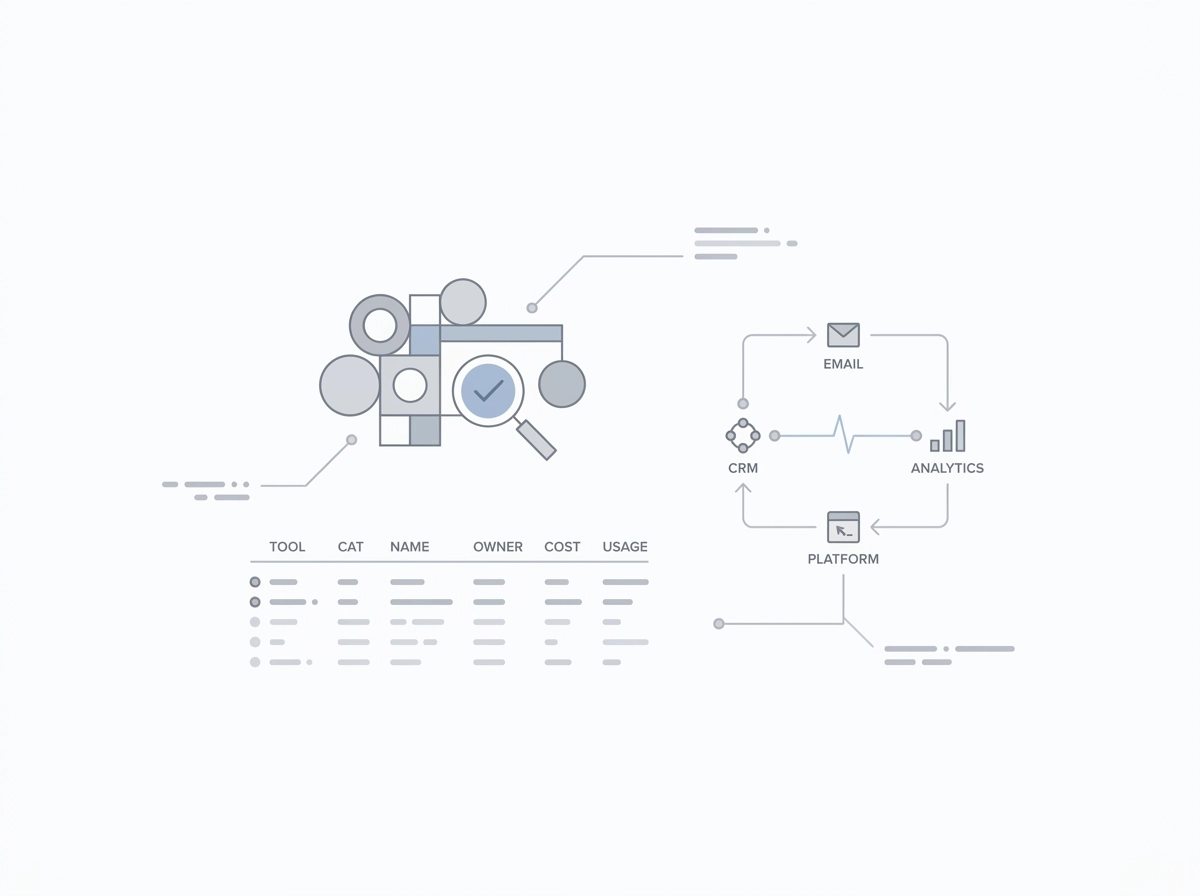
Build a living stack inventory. Create a spreadsheet with six columns: tool name, category (email, analytics, CRM, etc.), named owner, monthly cost, integration status (native, API, manual, or none), and last-used date. Populate every active subscription, including tools inherited from previous team members or campaigns. This single document surfaces redundancy and dead weight faster than any vendor evaluation process.
Evaluate utilization against cost. Flag any tool that is paid for but shows no activity in the past 60 days. Then flag tools that share primary functionality with another platform in your stack. Agency owners managing multi-client stacks frequently discover multiple subscriptions fall into one of these three problem categories on first audit.
Map your data flows. For each tool pair that should be exchanging data, document the actual mechanism: is the connection real-time, batch, or manual? Trace how contact records, campaign events, and behavioral signals move between platforms. Mark every gap where data stops moving. These gaps are where attribution breaks and where campaign signals get siloed. Tools without API access or native integrations are structural dead ends that cannot participate in automated data flows regardless of their feature quality.
Set rationalization criteria before you cut anything. Score each tool on four dimensions: integration maturity (does it connect reliably to your other layers?), AI-readiness (does it expose structured data via stable APIs?), data governance capability (can you control field mapping and consent status?), and category overlap. Decide keep, kill, or replace only after scoring, not before.
Ground stack changes in real visibility data. Before any campaign restructuring, establish a baseline for your organic keyword footprint and domain authority using your preferred SEO intelligence tools, so that stack changes can be evaluated against measurable visibility outcomes.
Step 2: Understand the Five Core Layers of a B2B Martech Stack
Once your audit reveals what you have and what’s missing, you need a structural model to build against. While no single industry standard defines martech stack layers universally, a useful practitioner framework organizes B2B stacks into five functional layers, each serving a distinct role. Understanding these layers prevents both redundancy and gaps as you build.
Layer 1: Campaign and Funnel Management
This is the entry architecture for your marketing operation. It governs how prospects discover your brand, enter a defined path, and progress toward a conversion event. ClickFunnels and Systeme.io both serve this layer with structured funnel builders that combine landing pages, offer sequencing, and email triggers in one environment, eliminating the need to stitch those elements together manually.
Layer 2: Email Marketing and Marketing Automation
This layer is your primary nurture engine. AWeber, Moosend, and HighLevel each handle segmented, behavior-triggered messaging at scale. Critically, none of these platforms operate effectively in isolation; they require bidirectional data connections to your CRM and integration layer to act on real-time contact signals rather than static lists.
Layer 3: Data Integration and Workflow Orchestration
This layer moves data between all other tools automatically, enabling the conditional, multi-step workflows covered in Step 4.
Layer 4: Analytics, SEO, and Campaign Intelligence
This layer converts campaign activity into decisions. SERPWatcher tracks keyword position changes over time; SERPChecker analyzes SERP composition; LinkMiner surfaces backlink opportunities; and Metricool consolidates social campaign reporting. Together, they give you the signal layer that informs where to push or pull resources.
Layer 5: Conversion, Client Management, and Operations
This is the revenue-facing layer. LiveChat qualifies inbound traffic in real time; Jotform captures and routes lead data through structured intake flows; Bizzy Clientflow AI manages post-conversion onboarding and client workflows. Every upstream layer ultimately feeds into this one.
Step 3: Build Your Automation and Email Infrastructure First
With your five-layer framework mapped, the next move is to build the center of it. As Layer 2 in your five-layer model, your email and automation platform is where every upstream signal lands and every downstream action originates, which is why it must be built first and built right. Build this layer wrong and every integration you add later inherits the same structural flaw.
Choose your platform posture before selecting a tool. HighLevel combines CRM, automation, pipeline management, and campaign sequencing in a single environment, which reduces tool count and eliminates several integration dependencies for teams that want consolidated control. AWeber and Moosend take a focused approach: purpose-built email infrastructure that connects cleanly to external CRMs and landing page tools through API connections or native connectors. Neither approach is universally superior; the right choice depends on whether your team prioritizes platform consolidation or best-of-breed flexibility.
Configure segmentation and behavioral triggers before importing any contacts. Build your list segments around traffic source, on-site behavior, and funnel stage from day one. Static list imports create flat, undifferentiated audiences that require constant manual maintenance. Behavioral segmentation scales automatically as contact volume grows because the logic triggers on actions rather than requiring human intervention to sort.
Validate your deliverability infrastructure before sending a single sequence. Use GlockApps to test inbox placement across major mail providers, diagnose SPF, DKIM, and DMARC authentication gaps, and assess sender reputation. Authentication failures that go undetected during setup will suppress deliverability across your entire contact base once you scale volume.
Wire every upstream touchpoint into your automation platform before launch. Form submissions from Jotform, funnel conversions from ClickFunnels or Systeme.io, and chat interactions from LiveChat must pass contact data and behavioral events into your automation platform in real time. Batch syncing introduces latency that breaks trigger-based sequences and degrades the precision of your segmentation logic.
Step 4: Connect Your Stack With a Data Integration Layer
With your email and automation infrastructure in place, the next failure point is data movement between tools. Even well-configured platforms become unreliable when data transfer depends on manual intervention.
Manual data transfer is an architecture failure, not a workflow inconvenience. Copy-paste processes, CSV imports, and manually triggered syncs introduce latency that corrupts multi-touch attribution. By the time a contact record updates across platforms, campaign reporting has already logged incomplete signals. B2B attribution chains break silently under these conditions, and teams rarely trace the reporting gap back to its source.
Use Make for Conditional, Multi-Step Workflow Automation
Make’s visual scenario builder lets marketing operations teams construct complex, branching data flows without code. A practical example: a Jotform submission triggers a qualification filter in Make; contacts meeting the criteria route into an AWeber or Moosend email sequence while a simultaneous action notifies the assigned sales rep. Contacts that fail the filter route to a separate nurture branch. This conditional logic is impossible to replicate reliably through manual processes or simple single-step triggers.
Use Pabbly Connect for High-Volume Integration at Flat-Rate Cost
Pabbly Connect‘s flat-rate pricing model removes the per-task cost ceiling that penalizes high-frequency B2B events. Webinar registrations, gated content downloads, and ad lead form submissions often spike during active campaigns. With Pabbly Connect, those events sync continuously across platforms without accumulating variable costs, making it a structurally sound choice for stacks processing large event volumes.
Map Before You Build
Before creating a single workflow, document every trigger, action, and data field involved. Identify which platform owns the record, which receives it, and which fields must match exactly. Undocumented architecture produces duplicate records and workflows that fire on unintended conditions. The Architecting the Modern B2B Tech Stack blueprints offer structured templates for this mapping process.
Stress-Test Before Going Live
Run bulk contact imports and simulate campaign event spikes against your workflows before launch. Identify where automations slow, timeout, or silently drop records under volume. Failures caught in testing do not affect live campaign data.
Step 5: Wire In Your Analytics and Campaign Intelligence Tools
With your data integration layer in place, the next priority is ensuring your analytics tools feed directly into campaign decisions rather than sitting in separate dashboards that no one acts on.
Isolated metrics are operationally inert. A keyword ranking shift only matters if it triggers a content update or bid adjustment. A backlink loss only matters if it prompts outreach. The goal is to connect your campaign execution tools to your intelligence layer so that signals produce responses, not reports.
Deploy the Mangools Suite for Search Intelligence
The four Mangools tools divide search intelligence into distinct functions:
- KWFinder surfaces high-intent, low-competition keywords to prioritize in content briefs and paid targeting.
- SERPWatcher tracks position changes over time, so you can correlate ranking movement with specific campaign milestones.
- SERPChecker maps the SERP composition for any target keyword, showing competitor positioning and content formats currently earning rankings.
- LinkMiner identifies backlink acquisition opportunities and monitors domain authority signals that affect your content’s ability to rank.
Run these tools on a defined cadence, weekly for active campaigns, monthly for baseline tracking, and document findings in a shared log that your content and paid teams can access.
Consolidate Social Reporting With Metricool
Metricool unifies social media scheduling, post-level performance analytics, and competitor benchmarking into one reporting layer. Use it to identify which content formats and posting cadences generate the most engagement across channels, then feed those findings directly into your content calendar decisions. This eliminates the guesswork that comes from managing platform-native analytics separately.
Apply SiteProfiler to Competitive Content Strategy
Before investing in SEO content targeting competitive terms, use SiteProfiler to benchmark competitor domain authority, organic traffic estimates, and backlink profiles. This calibration tells you whether a keyword requires significant link-building support before content can realistically rank.
Build a Unified Reporting Cadence
Align Metricool social data, Mangools search data, and email performance metrics from your automation platform into a single weekly or biweekly review. Decisions made from one channel’s data produce one channel’s results. A complete picture produces campaign-level outcomes.
Step 6: Add a Content and Creative Production Layer
With your analytics and campaign intelligence layer feeding actionable signals, the next constraint on campaign velocity is typically content production itself.
Content production speed is a stack design problem. B2B teams without integrated creative tooling bounce between disconnected platforms to produce video, voiceover, graphics, and copy, creating asset inconsistency and compressing the time available for actual distribution and optimization. The fix is treating content production as a formal stack layer with defined tools and workflow connections.
Video Production and Publishing
Flixier handles browser-based video editing, eliminating desktop software dependencies and the file-transfer friction that typically separates editing from publishing. Marketing teams can produce, edit, and export campaign videos directly in-browser, then push finished assets into distribution workflows without additional handoff steps.
Speechelo solves the voiceover bottleneck. It generates professional AI voice narration for explainer videos, product demos, and ad creatives without recording studio overhead. Because narration can be regenerated quickly when messaging changes, video assets tied to active campaigns can be iterated on the same day rather than waiting on external production resources.
YouTube SEO and Video Demand Generation
For B2B teams using YouTube as a demand generation channel, optimization is not optional. VidRankr provides ranking analysis and tag optimization to improve video discoverability. Pair it with VidIQ’s keyword research and competitor video intelligence tools to identify high-intent search terms before publishing and to benchmark content performance against competing channels. Both tools belong in the stack before your first video is uploaded, not after.
Visual Content and Design Assets
InstaDoodle brings design production inside your campaign workflow. Social graphics, ad creatives, and landing page visuals can be produced consistently without routing every iteration through external design resources. This keeps visual assets aligned with campaign messaging and eliminates approval delays that stall time-sensitive launches.
Together, these tools form a production layer that feeds finished assets directly into the distribution and analytics layers already wired into your stack.
Step 7: Close the Loop With Conversion and Client Management Tools
Content production fills your pipeline with assets. This step determines whether those assets convert, and whether conversions actually close.
The conversion layer has one architectural job: receive qualified signals from upstream campaign and nurture platforms, then pass structured lead and client data downstream to sales, onboarding, and retention workflows without dropping context. Any gap in that handoff means lost revenue and broken attribution.
Capture and Qualify With Jotform
Jotform gives your team a flexible form-building layer for intake forms, survey flows, and qualification questionnaires. Build multi-step forms that score respondents by budget, timeline, or use case before a record ever reaches your CRM. Route submissions directly via native integrations or through Pabbly Connect automation workflows and Make scenarios that filter, enrich, and segment contacts before they enter your email sequences.
Qualify Inbound Traffic in Real Time With LiveChat
LiveChat converts passive page visitors into active pipeline. Configure proactive chat triggers based on session depth, time-on-page, or pricing page visits so high-intent visitors are engaged before they exit. Route qualified conversations directly into your CRM pipeline or trigger email automation sequences for structured follow-up. This eliminates the lag between expressed interest and sales contact.
Automate Post-Conversion With Bizzy Clientflow AI
Winning a client without a structured onboarding process creates churn risk. Bizzy Clientflow AI automates proposal generation, client onboarding sequences, and project workflow management so every post-conversion experience follows a repeatable, documented process rather than relying on manual coordination from individual team members.
Extend Reach Without Increasing Paid Spend With Rewardful
Rewardful adds an affiliate and referral layer to your existing funnel infrastructure. Connect it to your payment system to automatically track referral conversions, calculate commissions, and manage payouts within a single workflow. This extends campaign reach through existing customers and partners without scaling paid media budget proportionally.
With this layer in place, your stack closes the full loop from first touch to signed client.
Step 8: Architect for AI Readiness and Orchestration
With your conversion layer fully connected, the next architectural priority is ensuring your stack can support AI orchestration, not eventually, but now.
As established in your audit, a stack built reactively cannot support AI orchestration, here is how to close that gap deliberately.
An AI-ready MarTech stack has four properties:
- Clean, consistent data schemas across platforms, meaning the same contact fields use the same naming conventions whether the record lives in your email tool or your CRM
- Event-driven integration architecture that produces real-time behavioral signals rather than batch-synced snapshots
- Documented, stable API layers on every tool in your stack so orchestration systems can read context and trigger actions programmatically
- Centralized workflow orchestration capable of accepting and acting on AI-generated instructions without manual intervention
Evaluate each tool against these criteria directly. Ask whether your automation platform, email infrastructure, and analytics layer expose the data access and webhook endpoints that AI agents require to read state and take action. Tools that cannot answer yes are architectural liabilities.
Make and Pabbly Connect are your orchestration-ready integration layers. Both support webhook-driven triggers, conditional branching, and multi-step workflows that can be extended to receive inputs from AI agents. They function as the bridge between AI orchestration tooling and your existing MarTech infrastructure without requiring a platform rebuild.
Start building structured data practices now. Standardize contact field naming, behavioral event taxonomy, campaign UTM structures, and list segmentation logic across every tool in your stack. When you introduce AI capabilities into your workflows, the agents will have clean, queryable data to work with rather than inconsistent records that require remediation before they can be used.
Step 9: Scale Your Stack Without Reintroducing Sprawl
With your AI-ready architecture in place, the next risk is growth-driven fragmentation. Research from MarTech.org confirms the pattern: organizations often reintroduce sprawl shortly after consolidation by adding point solutions reactively (62.9% of those who replaced a platform in 2025 simultaneously added new applications).
Apply a three-gate evaluation before every new procurement:
- Integration audit: Does the tool connect to your existing data layer via native integration or API? If it requires a manual export workflow to function, it is a fragmentation risk.
- Redundancy check: Does it duplicate functionality already covered by a current tool? Overlapping capability across platforms is the primary driver of wasted martech budget.
- Ownership check: Is there a named team member responsible for adoption, governance, and integration maintenance? Tools without assigned owners rapidly become shelfware.
When a B2B team needs a custom client portal, mobile dashboard, or lightweight internal tool, a no-code app builder like Adalo addresses that need without adding a standalone software silo. Adalo allows purpose-built app development that connects to your existing stack via API, extending functionality without expanding your tool count.
To manage complexity as your team grows:
- Maintain a living stack map that logs every integration change, not just new tool additions
- Assign tool ownership to specific roles, not teams, so accountability is unambiguous
- Schedule quarterly stack reviews to surface underutilized tools, expired integrations, and emerging category overlaps before they compound
Recognize when your architecture needs rebuilding, not patching. Clear signals include frequent manual data corrections, campaign attribution that cannot be traced end-to-end, integration workflows that time out under campaign volume, and new team members struggling to get operational due to undocumented tool configurations. At that point, optimization is no longer sufficient; the architecture itself requires restructuring.
Building a Stack That Works as a System, Not a Collection of Tools
Avoiding sprawl is the final operational discipline; this closing principle is the architectural mindset that makes every discipline stick.
Every tool in your stack must earn its place against three criteria: a defined role within one of the five layers, at least one active data connection to another layer, and a named owner accountable for its performance and integration health. A tool that fails any criterion is a liability, not an asset.
Follow the five-layer build sequence outlined in Step 2, automation first, then integration, intelligence, content, and conversion, with each layer connected before the next is added.
AI readiness is a quarterly discipline. Every 90 days, audit your stack for data schema consistency, API coverage across all active tools, and integration reliability under real campaign volumes, as covered in Step 8.
The rationalization-first principle applies at every stage of stack maturity. A tightly integrated five-tool stack consistently outperforms a fragmented fifteen-tool one. Depth of integration produces cleaner attribution, faster campaign execution, and more reliable data, all of which compound over time. Breadth without connection produces noise.
To take the next step, use the software architecture blueprints and category guides at b2btechstacker.com to map your current stack against the five-layer model, surface integration gaps, and identify tools with documented, proven connection paths for your specific B2B use case.
Conclusion
Building a martech stack that performs is not about collecting tools. It is about engineering a system where every layer reinforces the next.
The key takeaways are straightforward: audit before you add, sequence your build around the five core layers, prioritize depth of integration over breadth of coverage, and treat AI readiness as an ongoing discipline rather than a one-time setup.
Teams that follow this approach gain cleaner data, faster execution, and attribution they can actually trust. Teams that skip the sequencing keep paying for tools that work against each other.
Your next move is clear. Head to b2btechstacker.com, map your current stack against the five-layer model, and close your integration gaps with tools that have documented, proven connection paths.
A stack built as a system does not just support your marketing. It multiplies it.