
Skip the reading. Deploy this exact architecture and consolidate your B2B tech stack today.
Architecting Post-Purchase E-Commerce Loyalty
In the modern digital landscape, the phrase “customer acquisition” dominates the conversation. Startups, established enterprises, and bootstrapped digital storefronts pour massive amounts of capital into advertising, SEO, and top-of-funnel marketing strategies. However, securing a new customer is only the first step in a much longer journey. What happens after the transaction clears is often the defining factor that separates wildly successful businesses from those that constantly struggle to maintain profitability.
Acquiring a new B2B e-commerce customer is significantly more expensive than retaining an existing one. Despite this well-known business axiom, a surprising number of companies fail to implement cohesive post-purchase sequences. Their B2B lead funnels leak potential revenue because the software tools they rely on operate in isolated silos, completely disconnected from one another.
This comprehensive blueprint outlines exactly how to architect a frictionless B2B lead funnel. By connecting your storefront to an enterprise-grade customer relationship management (CRM) and email platform, you can trigger dynamic, behavioral-based campaigns the exact moment a transaction clears. Let’s dive deep into how you can deploy this automated retention engine to consolidate your tech stack and maximize customer lifetime value (LTV).
The Trap of Siloed Software Stacks
One of the most common pitfalls in digital business architecture is the “Frankenstein stack.” This happens when a company adopts different software platforms for different needs—one for a landing page, another for email marketing, a third for payment processing, and a fourth for customer support—without a centralized strategy for how these tools will communicate.
When tools exist in isolated silos, data becomes fragmented. A customer might successfully purchase a product on your storefront, but if that transaction data doesn’t instantly and seamlessly sync with your marketing engine, that customer is often thrown into a generic “newsletter” list. They receive irrelevant email blasts, generic promotions, and poorly timed messages that ignore the fact that they just made a purchase. This disjointed experience creates friction, degrades brand trust, and ultimately crushes any chance of building post-purchase loyalty.
To solve this, modern businesses must adopt an integration-first mindset. By utilizing middleware orchestrators, you can bridge the gap between platforms like ClickFunnels or Systeme.io and robust backend systems like GoHighLevel or Moosend. The goal is real-time data flow, where every customer action dictates a highly personalized, automated reaction.
Core Software Stack Requirements
To deploy this automated retention engine, your architecture will utilize a strategic combination of specialized platforms. Whether you are transitioning from ClickFunnels to GoHighLevel or building a lean stack with Systeme.io and Moosend, the principles remain the same. Here is the core stack required to execute this blueprint:
1. The Storefront and Checkout Engine (Systeme.io or ClickFunnels)
At the top of your post-purchase funnel sits the storefront. Platforms like Systeme.io offer a lightweight, highly efficient storefront and checkout engine that handles landing pages, sales funnels, and payment processing. Alternatively, heavyweights like ClickFunnels can serve this role. The crucial requirement for your storefront is the ability to fire webhooks or integrate via API the moment a charge is successfully processed.
2. The API Orchestrator (Make)
Make (formerly Integromat) is the glue that holds this entire architecture together. As a visual workflow builder, Make allows operations managers and developers to design and deploy complex programmatic operations without writing a single line of code. Make acts as the central nervous system of your tech stack. It listens for the purchase event from your storefront in real-time, captures the payload of customer data, and routes it intelligently to your backend systems based on specific conditional logic.
3. The CRM and Email Delivery Platform (Moosend or GoHighLevel)
Once the data is captured and routed, it needs a final destination where the marketing magic happens. Platforms like Moosend provide advanced behavioral segmentation and email delivery, while all-in-one CRMs like GoHighLevel can handle SMS, pipelines, and complex automation workflows. This is where your customer profiles live and where your highly targeted, post-purchase behavioral sequences are executed.
Step-by-Step Implementation Strategy
Architecting this flow requires a methodical approach. By following these core steps, you can eliminate manual tasks and ensure that your customers receive exactly the right message at exactly the right time.
The Visual Integration Flow
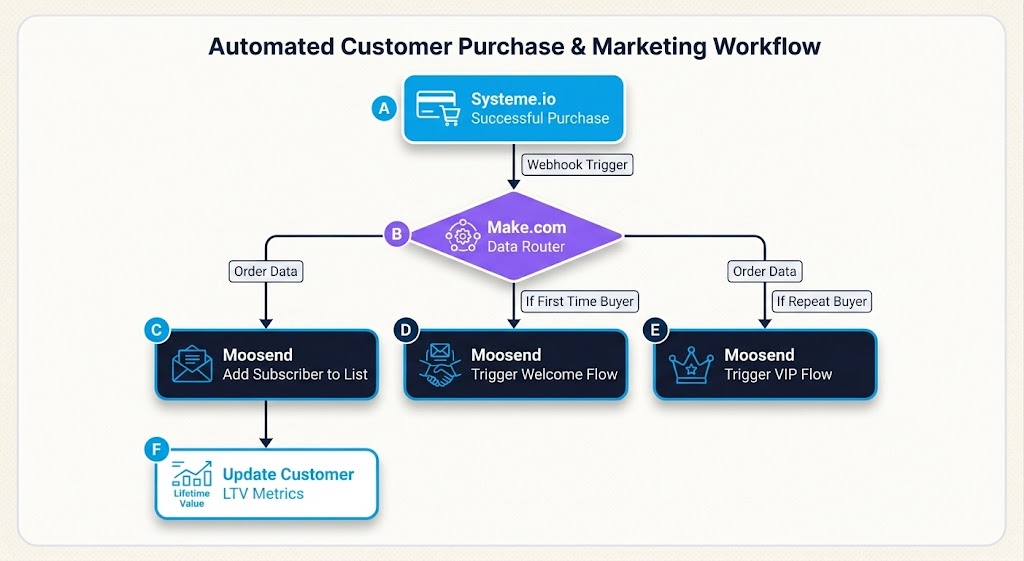
Review the architecture below to understand how purchase data dictates customer email segmentation.
Phase 1: Capturing the Transaction Event
The journey begins the moment a customer clicks “Buy Now.” You need to establish a webhook connection inside your storefront’s product settings (e.g., Systeme.io or ClickFunnels). A webhook is essentially an automated message sent from one app to another when a specific event occurs.
Whenever a successful charge occurs, your storefront will instantly fire a data payload. This payload typically contains critical information such as the customer’s first and last name, email address, physical address, the exact product ID purchased, the transaction amount, and a timestamp.
Make.com is set up to “catch” this payload instantly. Because Make operates in real-time, there is zero delay between the customer checking out and their data entering your integration flow.
Phase 2: Segmenting by Customer History
This is the phase where most businesses fail. The standard practice is to take the webhook data and dump it into a single, generic email list. Instead, a well-architected funnel utilizes conditional routing.
Inside Make.com, you can utilize internal data stores or cross-reference the incoming customer email with your CRM’s (Moosend/GoHighLevel) existing database. The automation asks a critical question: Has this email address purchased from us before?
Based on the answer, Make routes the data down different paths:
Path A: The First-Time Buyer. If there is no historical purchase data, the customer is routed down the new acquisition path.
Path B: The VIP Repeat Customer. If the system recognizes the email address and detects previous lifetime spend, the customer is routed down the loyalty path.
Phase 3: Triggering the Behavioral Sequences
With the data intelligently segregated, it is now pushed into Moosend or GoHighLevel to trigger specific behavioral sequences.
For First-Time Buyers: The API pushes the contact into a dedicated onboarding list. This triggers a specific brand introduction sequence. The initial emails shouldn’t be heavily promotional; instead, they should focus on customer success. Provide tutorials on how to use the product they just bought, introduce the founders, explain the company’s core values, and offer exceptional customer support. By building trust early, you set the stage for a highly profitable long-term relationship.
For VIP Repeat Customers: Repeat buyers don’t need the brand introduction—they already trust you. For these individuals, Make triggers a specialized VIP workflow. This sequence might immediately acknowledge their loyalty (“Welcome back!”) and offer an exclusive, time-sensitive loyalty discount on a complementary product or their next purchase. You can also trigger SMS messages via GoHighLevel to provide a more personalized, high-touch experience.
The Impact on Deliverability, Trust, and LTV
Why go through the effort of building out this middleware architecture instead of using native, basic integrations? The answer lies in domain reputation, engagement metrics, and Customer Lifetime Value (LTV).
By segregating the data before it hits your email engine, you guarantee maximum relevancy. When you send highly relevant emails—such as a tailored VIP discount to a repeat buyer, or a helpful setup guide to a first-time buyer—your open rates skyrocket.
High open rates and high click-through rates send powerful positive signals to inbox providers like Gmail and Outlook. This protects your domain reputation and ensures that your future marketing campaigns land in the primary inbox rather than the dreaded promotions or spam folders.
Furthermore, this frictionless post-purchase experience drastically reduces buyer’s remorse. When customers feel acknowledged, understood, and supported immediately after giving you their money, they are exponentially more likely to become brand evangelists and repeat purchasers, directly increasing your bottom line.
Conclusion
Architecting a frictionless B2B lead funnel isn’t just about capturing an email address at the top of a landing page; it’s about what you do with that data once the user transitions from a lead to a paying customer.
By leveraging the power of a storefront like Systeme.io or ClickFunnels, routing intelligent data in real-time via Make, and triggering hyper-personalized campaigns in Moosend or GoHighLevel, you can automate customer loyalty. Stop settling for fragmented software silos and generic email blasts. Deploy this dynamic architecture today, consolidate your tech stack, and watch your customer retention rates—and revenue—climb to new heights.