Skip the reading. Deploy this exact architecture and consolidate your B2B tech stack today.
Transforming Fragmented Tools into a Cohesive Agency Pipeline
In the highly competitive B2B service landscape, digital agencies and consultants are constantly battling software bloat. You are likely duct-taping various applications together, resulting in lost leads, dropped client communications, and a disjointed onboarding experience. To scale effectively without proportionately increasing your overhead, you need a streamlined, automated architecture.
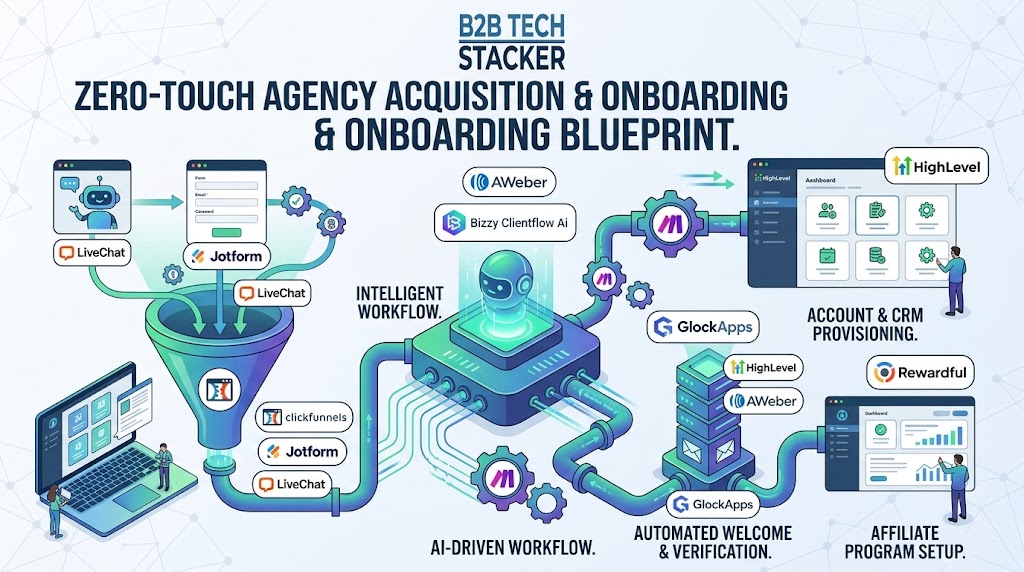
This workflow blueprint maps out an advanced, end-to-end integration strategy. By connecting specialized platforms into a unified data stream, you can automate your client acquisition, optimize intake, guarantee communication delivery, and establish an affiliate growth loop. Below, we break down exactly how to orchestrate this revenue engine.
Phase 1: The High-Converting Front End
Your tech stack begins at the point of traffic capture. The goal here is to maximize conversion rates before the user bounces.
1. Landing Page Architecture: We initiate the blueprint with ClickFunnels. As a dedicated funnel builder, ClickFunnels allows you to deploy high-converting, heavily tested page structures. Instead of relying on a standard corporate website, you route your paid and organic traffic to a focused ClickFunnels landing page designed with a single call to action—booking a consultation or downloading a lead magnet.
2. Real-Time Engagement: High-ticket B2B leads often have immediate, specific questions. By embedding LiveChat onto your ClickFunnels pages, you can intercept high-intent visitors. Configure LiveChat with proactive greetings tailored to the exact page they are viewing. If a visitor lingers on the pricing or services page for more than 45 seconds, the chat automatically triggers, moving them from a passive reader into an active conversation.
Phase 2: Intelligent Intake and Clientflow Generation
Once the prospect signals interest, the transition from “lead” to “onboarded client” must be frictionless and entirely automated.
3. Advanced Data Collection: Instead of simple contact forms, route your qualified prospects to a Jotform embedded on your post-opt-in page. Jotform’s conditional logic allows you to dynamically alter the questions based on the prospect’s industry or budget. If they select a budget over $10,000, the form expands to ask strategic architecture questions; if below, it routes them to a lower-tier self-service option.
4. AI-Powered Client Communication: Generating custom proposals and follow-up sequences manually is a severe bottleneck. Here, we integrate Bizzy Clientflow AI. By utilizing its engineered communication assets and prompt templates, you can instantly feed the data captured from Jotform into AI-driven outreach scripts. This ensures that the moment a client finishes the intake, your team has a personalized proposal and a 7-day onboarding follow-up plan ready to deploy.
Phase 3: The Central Operations Hub and Workflow Automation
With data captured and communication assets generated, we need an engine to synchronize this data across your ecosystem without manual data entry.
5. The Automation Layer: We utilize Make (formerly Integromat) as the visual workflow router. Make listens for the Jotform submission webhook. Once triggered, Make executes a multi-step scenario: it pushes the data into your central CRM, formats the client details, and triggers the necessary operational tasks for your team.
6. The Central CRM: Make routes the refined data directly into GoHighLevel. GoHighLevel serves as the absolute core of this architecture. It replaces fragmented pipeline tools by consolidating CRM, SMS follow-ups, and calendar bookings into one dashboard. Make updates the GoHighLevel opportunity stage to “Onboarding,” which automatically triggers a GoHighLevel SMS to the client thanking them for their submission and confirming their kickoff call time.
Phase 4: Specialized Email Marketing and Deliverability Assurance
While GoHighLevel handles core transactional messages, long-term nurturing often requires specialized infrastructure to maintain list health and complex broadcast segmentation.
7. Long-Term Nurturing: Make simultaneously pushes the new contact’s email to AWeber. AWeber manages your macro-level agency newsletters and educational drip campaigns. By isolating broad email marketing into AWeber, you protect your GoHighLevel transactional IP reputation.
8. Deliverability Monitoring: B2B sales cycles depend entirely on email visibility. If your proposals land in the spam folder, the entire architecture fails. We integrate GlockApps to continuously test both your AWeber broadcast infrastructure and your GoHighLevel transactional SMTP. GlockApps runs automated inbox placement tests across Gmail, Outlook, and corporate filters. If your domain reputation drops, GlockApps alerts you immediately, allowing you to pause campaigns before permanent damage occurs.
Phase 5: Scaling Through Partnerships
The final layer of this blueprint turns your satisfied clients and agency partners into a decentralized sales force.
9. Affiliate Infrastructure: We deploy Rewardful connected directly to your Stripe account. Because Rewardful integrates instantly with Stripe, any client who refers another business to your agency is automatically tracked. When a new retainer is billed via Stripe, Rewardful correctly attributes the recurring commission to the referring partner. GoHighLevel can be configured to automatically send an invite to your Rewardful program the moment a client reaches the “Project Completed – Success” stage in your pipeline.
Deep Dive: Configuring the GoHighLevel & Make Pipeline
To truly understand the power of this integration, we must look at the specific data handling within Make. When configuring your Make scenario, your first module will be a custom webhook listening for the Jotform submission payload. Because Jotform transmits data in real-time, Make instantly parses the JSON data. The crucial step here is utilizing Make’s built-in text parsers and router modules. If the Jotform data indicates a ‘High-Value Enterprise Lead’, the router directs the flow down a specialized path.
This specialized path utilizes the GoHighLevel API module in Make. You will map the fields: First Name, Last Name, Phone, and Email directly into GoHighLevel’s contact record. But more importantly, you will use Make to append custom tags (e.g., ‘Enterprise’, ‘Inbound-Organic’) and assign the lead to a specific high-ticket closer on your sales team within GoHighLevel. Simultaneously, Make triggers a GoHighLevel pipeline stage update, shifting the contact into the ‘Needs Immediate Contact’ column. This shift inside GoHighLevel natively triggers a workflow that sends a ringless voicemail to the prospect and an internal push notification to your sales rep’s mobile app. This orchestration eliminates the dangerous 15-minute window where cold leads typically go dead.
Deep Dive: Enhancing Deliverability with GlockApps & AWeber
Email marketing is structurally fragile. Agencies frequently face a catastrophic issue: they send an important GoHighLevel proposal, and it lands in the Google Workspace Promotional or Spam folder because their domain reputation was damaged by a previous bulk marketing blast. This is why segregating traffic is critical.
By routing all bulk, top-of-funnel newsletters through AWeber, you isolate the risk. AWeber has decades of built-in sender authority and stringent compliance teams that help protect your deliverability. However, you must proactively monitor the health of your primary domain. This is where GlockApps becomes an indispensable diagnostic tool. You should set up a weekly automated GlockApps test. GlockApps will provide a seed list of test email addresses spanning multiple ISPs (Gmail, Yahoo, Outlook, AOL). You send a standard broadcast from AWeber and a transactional test from GoHighLevel to this seed list. GlockApps then generates a comprehensive dashboard showing exactly where the emails landed. If GlockApps detects a sudden spike in spam placement on Microsoft servers, it provides actionable technical feedback—such as adjusting your SPF, DKIM, or DMARC records, or altering spam-triggering language in your templates—before your live campaign is compromised.
Advanced Setup: The Rewardful Affiliate Ecosystem
Scaling a B2B agency on paid ads alone shrinks margins rapidly. A performance-based referral network is the ultimate moat. Integrating Rewardful is surprisingly elegant due to its native Stripe coupling. Unlike clunky legacy affiliate software that requires complex API handshakes to track refunds or upgrades, Rewardful lives in your Stripe dashboard.
When you set up a new client in GoHighLevel, part of the automated onboarding sequence should include an invitation to your affiliate portal. Rewardful provides them with a unique tracking link. When that client shares the link, Rewardful places a cookie on the visitor’s browser. If that visitor eventually signs a retainer and pays your Stripe invoice via your ClickFunnels checkout page, Rewardful instantly recognizes the transaction. It automatically calculates the recurring commission (e.g., 20% lifetime) and queues the payout. Furthermore, if a client upgrades their tier or downgrades, Rewardful adjusts the affiliate commission in real-time without manual intervention. This creates a zero-friction, highly motivated outsourced sales team acting on your behalf.
Conclusion
By implementing this blueprint, you transform disjointed software subscriptions into a streamlined operational machine. ClickFunnels and LiveChat secure the lead; Jotform and Bizzy Clientflow AI structure the engagement; Make and GoHighLevel automate the pipeline; AWeber and GlockApps ensure communication delivery; and Rewardful builds a self-sustaining growth loop. This is the exact architecture required to scale a modern B2B service agency.