
Skip the reading. Deploy this exact architecture and consolidate your B2B tech stack today.
The Future of App Development: Harnessing the Power of AI and No-Code Platforms Together
We are currently living through two of the most significant technological paradigm shifts of the 21st century: the explosion of generative Artificial Intelligence (AI) and the rapid maturation of No-Code development platforms. Individually, these technologies are disruptive; combined, they are revolutionary. They represent a fundamental democratization of software creation. Today, we delve into how ambitious founders, developers, and businesses can harness the immense power of AI and seamlessly integrate it into custom applications using Adalo, without writing complex code.
The Convergence of AI and Visual Development
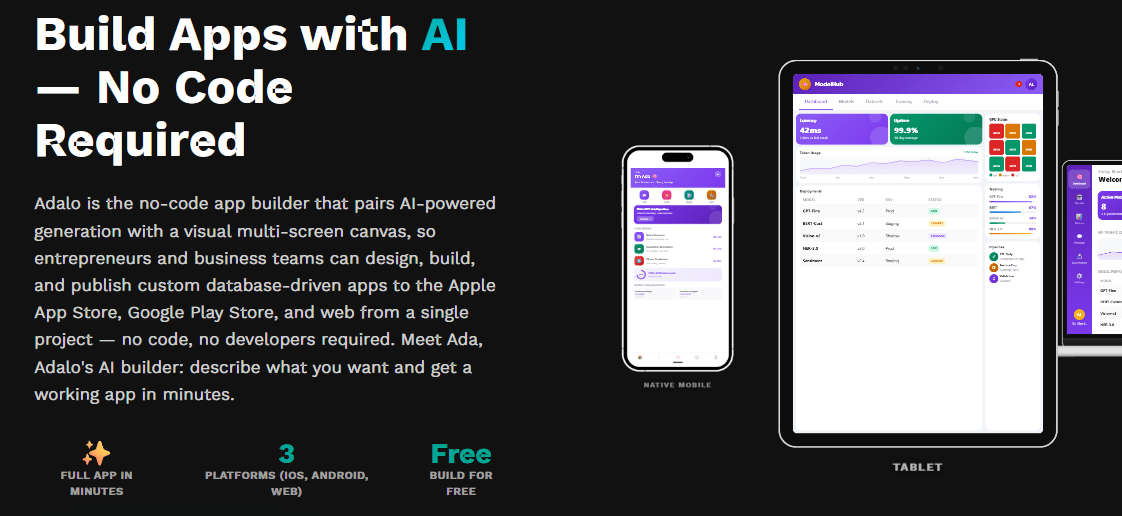
For a long time, integrating Artificial Intelligence—like Natural Language Processing (NLP), image generation, or predictive analytics—into software was the exclusive domain of highly specialized machine learning engineers. You needed massive datasets, deep mathematical knowledge, and powerful computing infrastructure. The introduction of accessible AI APIs (like those from OpenAI, Anthropic, or Google) changed everything. The intelligence is now available on-demand in the cloud.
However, an API is just raw data. To make AI useful to the average consumer or business user, it needs an interface. It needs an application wrapper that handles user inputs, manages context, and displays the AI’s output in a structured, actionable way. This is exactly where no-code steps in. Platforms like Adalo provide the canvas to build these interfaces rapidly, allowing anyone to productize AI capabilities in days rather than months.
The No-Code Revolution in the Technology Industry
For decades, software development was a walled garden. If you wanted to build an application, you needed to hire a team of developers, spend tens or hundreds of thousands of dollars, and wait months for a minimum viable product (MVP). This traditional model created an immense barrier to entry, stifling innovation and keeping brilliant ideas locked away in the minds of founders and business owners who lacked the technical skills or financial resources to bring them to life.
Today, the landscape has fundamentally shifted. The rise of no-code platforms like Adalo has democratized the creation of digital products. But what exactly does “no-code” mean in the context of Technology? It means that the visual interfaces, logic flows, and database structures that once required lines of complex code (like Swift, Kotlin, or React Native) can now be built using intuitive, drag-and-drop mechanics. You act as the architect, while the platform automatically translates your visual design into production-ready code.
This is particularly transformative for Technology. Businesses in this sector are constantly under pressure to adapt to changing consumer expectations, streamline operations, and deliver seamless digital experiences. When a company can bypass the traditional development bottleneck, they can rapidly prototype, test, iterate, and deploy solutions at a fraction of the cost and time. Whether it’s an internal tool to manage operations or a consumer-facing application designed to drive engagement, no-code empowers domain experts—the people who actually understand the business problems—to become the builders of the solutions.
The implications are profound. We are moving from an era where technology dictates business strategy to one where business strategy seamlessly dictates technology. By leveraging Adalo, companies in the Technology space can maintain a competitive edge, iterate based on real user feedback in real-time, and focus their capital on marketing and growth rather than exorbitant engineering salaries.
How Adalo Bridges the Gap to Artificial Intelligence
Integrating AI into an Adalo application relies on the platform’s ability to communicate with external web services via REST APIs. Adalo’s “Custom Actions” feature is the bridge between your app’s user interface and the computational brain of an AI model.
Here is how the architecture typically flows:
- User Input: A user interacts with your Adalo app. They might type a prompt into a text field, upload a photo, or select options from a dropdown menu.
- The Custom Action: When the user clicks a button (e.g., “Generate Text” or “Analyze Image”), Adalo triggers a Custom Action. This action packages the user’s input data and sends it as an HTTP request (a POST request) securely to the AI provider’s API (e.g., the OpenAI API).
- AI Processing: The AI provider processes the request on their massive server clusters and generates a response.
- Data Retrieval and Display: The API sends the response back to your Adalo app. Adalo catches this data payload, parses it, and instantly displays it on the screen for the user—perhaps populating a text box with a generated article, displaying an AI-created image, or updating a database record with a sentiment analysis score.
Practical AI Applications You Can Build Today
The use cases are constrained only by imagination. By connecting Adalo to AI APIs, you can build profoundly useful applications:
- Personalized Tutors and Coaches: Build an educational app where users chat with an AI fine-tuned on specific subject matter. The Adalo app handles the chat interface, user history, and payment gateways, while the AI provides the tutoring.
- Automated Content Generators: Create a marketing tool tailored for a specific niche (e.g., real estate). Realtors input property details into an Adalo form, and the app uses AI to generate compelling property descriptions, instantly ready for export.
- Intelligent Data Analysis: Build an internal business app where employees log customer feedback. The app can automatically send this feedback to an AI for sentiment analysis and categorization, updating the Adalo database in real-time to alert managers to unhappy clients.
- Custom Image Creation Tools: Leverage APIs like DALL-E or Midjourney to create apps that generate custom avatars, design mockups, or personalized greeting cards based on user selections within your Adalo interface.
True Cross-Platform Capabilities: Web, iOS, and Android

In today’s multi-device world, users expect to interact with your brand seamlessly across their smartphones, tablets, and desktop computers. Developing separate applications for each of these platforms using native languages (Swift for iOS, Kotlin for Android, HTML/JS for Web) essentially means building and maintaining three different software products. This triples your costs, triples your development time, and creates massive headaches when trying to keep feature parity across platforms.
This is where Adalo truly shines. It operates on a “build once, deploy everywhere” philosophy. When you design your application’s user interface and define its underlying logic within the Adalo canvas, you are creating a unified foundation. From this single source of truth, Adalo can generate a Progressive Web App (PWA) that runs perfectly in any web browser, alongside fully native applications tailored for iOS and Android devices.

For Android users, this means an app that respects Google’s Material Design principles and integrates smoothly with the Android operating system.

For iOS users, it means a crisp, fluid experience that feels right at home on an iPhone or iPad. And for web users, it means immediate access without the friction of an app store download.

This cross-platform approach not only dramatically reduces your initial time-to-market but also simplifies long-term maintenance. When you want to introduce a new feature, tweak your design, or update your database structure, you make the change once in Adalo. That update is then propagated across all your platforms simultaneously, ensuring a consistent and unified user experience. This level of efficiency is what allows lean startups and agile teams to compete with enterprise-level corporations.
Navigating the App Store Publishing Process

Building your app is only the first half of the journey; getting it into the hands of your users is the crucial second step. Historically, publishing an app to the Apple App Store or Google Play Store was a labyrinthine process filled with technical hurdles, strict compliance checks, and confusing certification requirements. One of the most significant advantages of using Adalo is how it streamlines this notoriously difficult phase.
When you build a native application, you aren’t just creating a mobile-responsive website. You are generating a standalone software package—an APK or AAB for Android, and an IPA for iOS. Adalo automatically compiles these packages for you. You don’t need to open Android Studio or Xcode, deal with complicated provisioning profiles, or manually manage SDK versions. The platform handles the heavy lifting of code compilation in the cloud.
Furthermore, navigating the review guidelines of Apple and Google requires precision. Adalo provides comprehensive documentation, automated checks, and a streamlined interface to ensure your application meets the necessary technical criteria before submission. This includes managing app icons, splash screens, permission requests (like camera or location access), and push notification certificates.
The ability to update your app post-launch is equally critical. In the traditional development world, pushing an update requires submitting a new build to the app stores and waiting for approval. With Adalo, many structural and content updates can be pushed over-the-air (OTA) directly to your users’ devices, ensuring they always have the latest version of your product without the friction of a forced download. This agility is a game-changer for maintaining user satisfaction and addressing bugs or adding features rapidly.
Conclusion: The Era of the AI-Empowered Builder

We are entering an age where the barrier to creating highly intelligent software approaches zero. You no longer need to be a machine learning expert to build an AI company; you simply need a problem to solve and the creativity to design the solution. By marrying the profound cognitive capabilities of modern AI with the rapid, visual development environment of Adalo, you can build products that were science fiction just a few years ago.
The competitive advantage belongs to those who move fast, iterate quickly, and deploy intelligent solutions directly into the hands of their users. Whether you are launching a new startup or optimizing an existing enterprise, the combination of AI and no-code is your most powerful lever. Start building the future today.